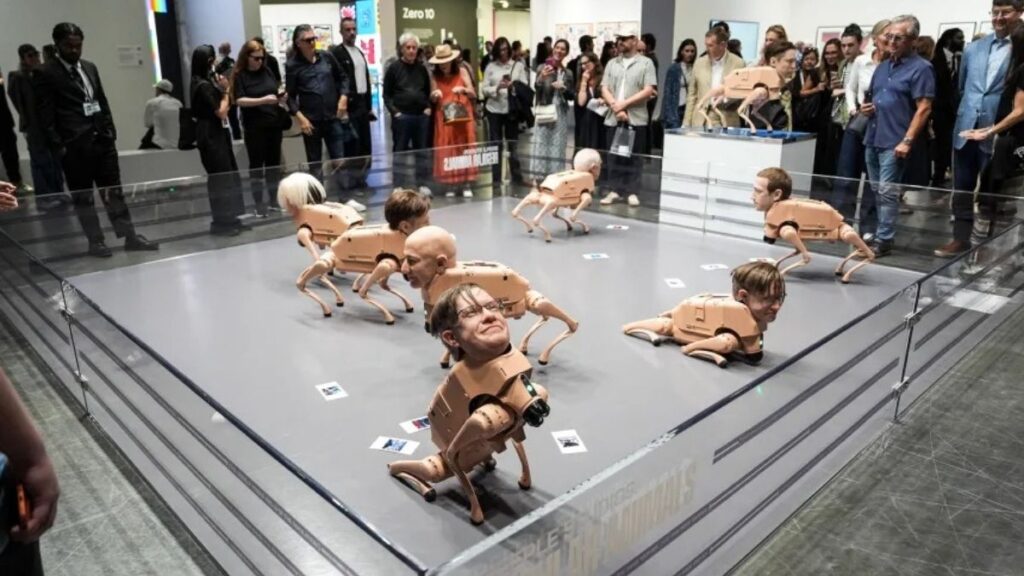
You know that moment when you see something so strange that your brain needs a second to load? That’s exactly what happened at Art Basel Miami Beach when Beeple rolled out a pack of robot dogs wearing hyper-realistic heads shaped like Elon Musk, Jeff Bezos, Andy Warhol, Picasso, Mark Zuckerberg and even a version of himself. And yes, these robot dogs take pictures and “poop” them out as printed AI-generated art. It sounds insane, but the deeper you look, the more you realize Beeple is making one of the sharpest points about tech, fame and the weird digital world we live in.
I’ve been covering digital art, NFTs, tech-driven installations and creator culture for years, and I’ve seen plenty of bold experiments. But Beeple’s new installation, called Regular Animals, hits different. The mix of robotics, AI art, satire, celebrity culture and social commentary makes this one of the most important pieces at Art Basel 2025. It also reflects Beeple’s authority as a leading digital artist whose works continually challenge the boundaries of what counts as “art”. This breakdown explains the installation in detail, the technology behind it, and the meaning Beeple is trying to hammer into the global art scene.

What Exactly Did Beeple Build?
The installation features a group of animatronic robot dogs inside a clear plexiglass pen. Each dog has a silicone sculpted head modeled after famous tech titans and cultural icons. These heads are disturbingly realistic and look like they came straight out of a sci-fi movie. The dogs walk, tilt their heads, scan the room and constantly take photos with a camera fixed to their chest. Those photos are pushed through an AI system that blends neural filters and generative algorithms to re-style the images in real time. Then the robots “print” the stylized images from their back end, turning the whole thing into a kind of satire about how modern tech processes our world.
Also Read: iPhone Upgrade Guide: What Changes in iOS 26.2 and Why It’s Time to Leave iOS 18
Why Tech Billionaires and Art Legends?
Beeple isn’t doing this to be weird for the sake of being weird. The billionaire heads represent how much control tech giants have gained over the way people create, consume and understand art. Musk, Zuckerberg and Bezos have shaped algorithms, platforms and digital spaces that define what goes viral and what gets buried. By turning them into robot dogs that eat, scan and spit out content, Beeple is poking fun at how we let tech leaders shape culture. Warhol and Picasso appear because they symbolize the “old world” of art, and Beeple blends them in to show how the line between tech culture and traditional art is gone now.
The Robot Dogs Are More Than a Gimmick
The real magic is the AI system hidden inside the installation. The robots aren’t just taking random photos. They scan people, colors, movement and patterns in the room. The AI processes them with style-transfer filters, similar to the tech used in modern generative art tools. Some prints come out distorted, some surreal, some extremely stylized. Each print is unique and works like a micro artwork born from a mix of machine vision, digital processing and physical output. Many prints come with QR codes linked to NFTs, pushing the idea that digital and physical art are merging into one continuous loop.
The Viral Reaction — Shock, Laughter, Confusion
People at Art Basel had no idea what to make of it at first. Some were laughing, some were filming everything, and others were creeped out by the hyper-real human heads on robotic dog bodies. But the internet reaction was even louder, with clips blowing up across Instagram, TikTok and Twitter within hours. Words like “dystopian”, “cyberpunk”, “genius”, “uncanny” and “WTF” kept appearing because this installation hits every nerve of our current digital age. It’s funny, it’s spooky, it’s smart and it forces you to look at how tech shapes every corner of your life.
The Message Beeple Wants You to Notice
Beeple is framing a bigger question: Who is actually shaping our vision of the world — artists or algorithms?
In a world ruled by recommendation systems, machine-made content and billionaire-owned platforms, our understanding of art, news and creativity is filtered before we even see it. These robot dogs show that process in the most literal and ridiculous way possible. They take in the real world, feed it through AI code, and release it back as something branded, distorted and influenced by the heads they wear.
Why This Installation Matters
This is one of the most talked-about installations of Art Basel 2025 for a reason. It blends physical robotics, digital art, satire, AI commentary and NFT culture in a way no one has done before. It captures the tension between old art and new tech. It makes people ask questions about surveillance, digital identity and creativity in an algorithm-driven world. And most importantly, it shows how art can still push limits in a time where everything feels automated.

Final Thoughts
Whether you think the robot dogs are brilliant or bizarre, you can’t deny Beeple is pushing the conversation forward. He’s proving that art today isn’t just about beauty or expression — it’s about reflecting the strange world we’re all living in. And if that means Musk and Bezos get turned into picture-pooping robot dogs, then honestly, Beeple might be onto something.
FAQ
Q1: What is Beeple’s “Regular Animals” installation?
Beeple’s “Regular Animals” is an AI-powered robotic art installation at Art Basel featuring animatronic robot dogs with realistic heads modeled after figures like Elon Musk, Jeff Bezos and Andy Warhol. These robots take photos, process them through AI and print the results as physical art pieces.
Q2: Why did Beeple use tech billionaires and famous artists?
He used them to highlight how tech leaders and cultural icons shape modern creativity, online platforms and the way people experience art. It’s satire mixed with commentary on influence and power.
Q3: How do the robot dogs create the printed images?
Each robot dog has a camera on its chest that captures real-time images. Those images go through an AI style-transfer system that transforms them into stylized artwork before printing them out the back of the robot.
Q4: Is the installation connected to NFTs?
Yes. Some prints include QR codes that link to related NFTs, blending digital art, physical pieces and blockchain-based ownership.
Q5: Why is this installation going viral online?
People are shocked and fascinated by the mix of realism, robotics, humor and social critique. Videos of the robot dogs have spread fast across social media because the concept is bizarre, funny and thought-provoking.