A Flash of Light from the Deep Unknown
Interstellar Comet 3I: You know that feeling when you think you’ve seen it all, and then space proves you wrong again? That’s exactly what happened with Comet 3I/ATLAS, the mysterious interstellar visitor now baffling scientists around the world. Out of nowhere, this icy traveler suddenly brightened — dramatically, and for no clear reason. And if that wasn’t enough, telescopes detected something even stranger: nickel-rich vapour streaming from its surface. That’s not something comets from our Solar System usually do. This new evidence has cracked open fresh questions about how comets form — and what secrets they carry from far-off star systems.

Interstellar Comet 3I :The Third Interstellar Guest in History
Let’s rewind a bit. Before 3I/ATLAS, we only knew two confirmed interstellar objects — ‘Oumuamua (1I/2017) and Comet Borisov (2I/2019). Both came racing into our Solar System on hyperbolic trajectories, proving they came from beyond the Oort Cloud. Then, in 2025, astronomers spotted something special. A faint dot was moving in a way that made no sense — not orbiting the Sun, but passing through. They labeled it 3I/ATLAS, the third interstellar object ever recorded, named after the ATLAS survey that first caught its glow. This meant another piece of alien material had wandered into our neighborhood — a priceless chance to peek into another planetary system’s chemistry.
Learn how space weather shapes comets: Tropical Storm Melissa 2025
An Interstellar Traveler with a Story to Tell
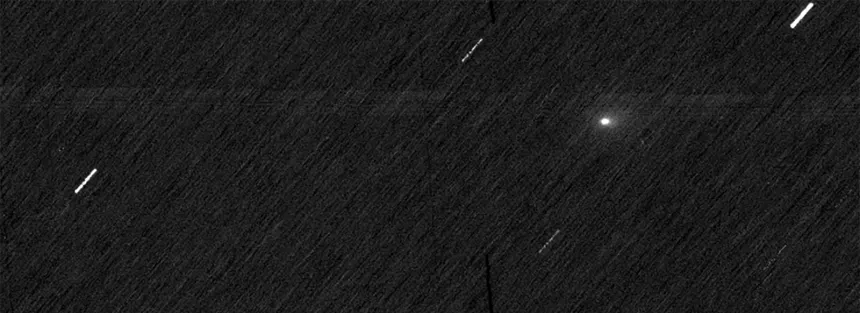
Unlike the strange cigar-shaped ‘Oumuamua, which didn’t have a visible tail, 3I/ATLAS looked more like a classic comet. It had a glowing coma and a bright tail, both signs of outgassing — the process where sunlight heats frozen ices, turning them into jets of gas and dust. But here’s where things get interesting. Spectroscopic data revealed that the coma was dominated by carbon dioxide (CO₂) rather than the usual mix of water and carbon monoxide seen in most Solar System comets. That detail alone hints that 3I/ATLAS was born under very different conditions — perhaps in a colder, CO₂-rich region of a distant protoplanetary disk.

The Brightening Nobody Expected
In late October 2025, scientists using observatories from Hawaii to Chile began reporting something shocking. The comet’s brightness had suddenly increased — not by a little, but by a factor that couldn’t be explained by its distance from the Sun. Normally, comets brighten gradually as they approach perihelion, the point closest to the Sun. But 3I/ATLAS seemed to flare up out of nowhere. Some astronomers compared it to a cosmic “flashbulb moment.”
At first, theories ranged from simple dust jets to massive surface fractures. But as data poured in, none of the usual models fit. The light curve and spectral analysis pointed toward something deeper — a change in composition rather than just reflection.
Discover technology powering interstellar research: From Text to Wheels: How Embedding GPT-5, Gemini 2.5 Pro…
Nickel: The Cosmic Clue Hidden in the Glow
When researchers looked closer using infrared and ultraviolet spectroscopy, they found a signature that made everyone sit up. The comet was releasing nickel vapour, along with traces of iron — both detected as metallic emissions in the coma. This was stunning. Nickel and iron are high-temperature elements, usually locked inside rocks and cores, not evaporating in space. Finding them in vapour form suggested that 3I/ATLAS was shedding metallic particles as it passed near the Sun. And this wasn’t the first time something like this had been seen — a few Solar System comets have shown nickel-iron signatures, but always in minute quantities.
For 3I/ATLAS, the nickel-to-iron ratio was different, pointing to a unique chemical fingerprint. It could mean the comet was born in a region of its home star system where metals condensed differently — or that its parent system was chemically distinct from ours.

What Makes It Truly Alien
This isn’t just about pretty tails or bright flares. Every molecule and atom in 3I/ATLAS tells a story of cosmic diversity. If the nickel-rich vapour and CO₂-dominated coma are confirmed, it means we’re seeing planetary chemistry beyond the Milky Way’s norms.
Think about that for a second. A piece of another world — built under another star — is literally disintegrating in our sky, offering a one-of-a-kind chemical snapshot of an extrasolar system. Even more intriguing is the hyperbolic orbit it follows. Its path and velocity confirm that 3I/ATLAS is not gravitationally bound to the Sun. It came from somewhere else entirely — possibly ejected during the violent formation of another solar system billions of years ago.
A Cosmic Mystery Wrapped in Ice
Astronomers are now trying to model how a comet could flare like this. One hypothesis points to sublimation of exotic ices — perhaps ammonia hydrates, CO₂, or methane — buried under a crust that cracked open as the comet neared sunlight. Another idea involves electrostatic discharge or volatile pockets suddenly venting gas, causing the visible outburst.
But the metallic vapour complicates things. Nickel doesn’t sublimate easily, even in intense solar heat. So why is it showing up? Some think micrometeorite impacts or internal heating might be releasing these metals. Others suggest that 3I/ATLAS’s parent star system had a unique blend of materials, meaning the comet was born metal-rich. Either way, this is not a normal comet.
Explore more cosmic mysteries: Taal Volcano’s Recent Short Eruptions
Telescopes Racing to Catch Every Second
Every major observatory — from the Very Large Telescope in Chile to NASA’s JWST — has turned an eye toward 3I/ATLAS. They’re tracking its light curve, measuring outgassing rates, and capturing spectral lines to build a full chemical map. Even amateur astronomers have joined in, logging brightness changes nightly. Data from space telescopes like Hubble and Gaia will help reconstruct the trajectory backward — possibly revealing the region of space it came from. If they can trace its origin, we might learn which star system launched this icy wanderer millions of years ago.
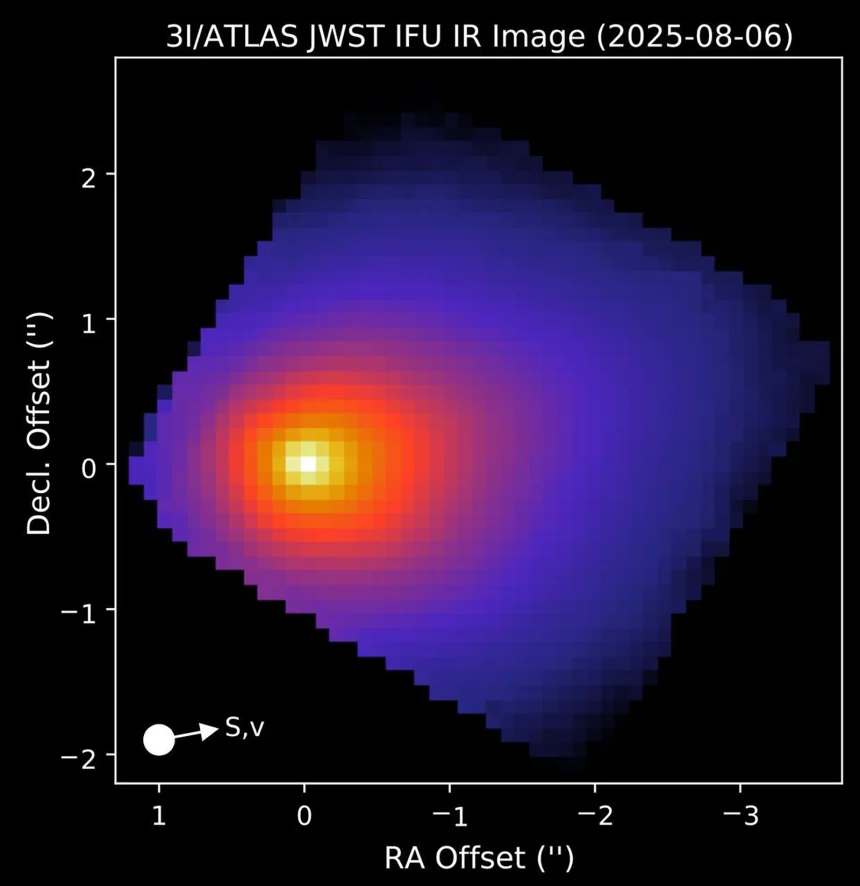
James Webb Space Telescope/NASA
Lessons from the Past: ‘Oumuamua and Borisov
Comparisons are inevitable. ‘Oumuamua, the first interstellar object, was dry, tumbling, and oddly shaped — like a shard from an alien world. Comet Borisov, the second, behaved more like a traditional comet but with unusual gas ratios. Now, 3I/ATLAS bridges the two — a true comet with familiar structure but alien chemistry. It’s a reminder that the interstellar medium is full of diverse materials — and that our Solar System is just one of many possible recipes in the cosmic cookbook.
Could It Reveal How Planets Form Elsewhere?
Absolutely. By analyzing the nickel-to-iron ratio, scientists can infer temperature gradients and dust condensation zones from the comet’s birthplace. It’s like a geological fingerprint of an entire planetary nursery. If that ratio differs from our comets, it means that other star systems form their worlds under different conditions — maybe leading to planetary types we’ve never imagined. In other words, 3I/ATLAS isn’t just a comet. It’s a messenger — a frozen time capsule carrying clues about how matter evolves across galaxies.
The Bigger Picture: A Universe of Wanderers
Astronomers now believe there may be billions of interstellar objects like this drifting through the Milky Way. Most go unnoticed, too faint or too fast to detect. But each one we catch — like 3I/ATLAS — gives us a rare window into alien chemistry and the origins of planetary systems. As detection technology improves, we’ll likely see more of these cosmic visitors — and maybe even send a spacecraft to chase one down someday. Imagine landing on a comet that was born around another star. That would be the ultimate time machine — touching material older and more distant than anything on Earth.
What’s Next for 3I/ATLAS
As 3I/ATLAS speeds away from the Sun, its brightness will fade. But the data it left behind will fuel research for years. Scientists are now comparing its spectral data to known Solar System comets, looking for patterns or anomalies. If the nickel-iron vapour and CO₂ dominance hold up, it might redefine how we classify interstellar comets — as their own category of metal-bearing wanderers. Some even think this could hint that planet formation processes across the galaxy are more varied than we’ve ever thought.
Final Thoughts: The Visitor That Changed Everything
When you look up and see a comet, you’re staring at a frozen piece of history. But 3I/ATLAS isn’t just history — it’s a story from another world, whispered through light and gas. Its sudden brightening, nickel-rich vapour, and alien chemistry have forced us to rethink how planets, stars, and systems evolve. It’s proof that the universe still surprises us — and that sometimes, the smallest flash in the night sky can rewrite everything we thought we knew.
FAQs
1. What makes 3I/ATLAS different from other comets?
It’s only the third confirmed interstellar comet, meaning it came from outside our Solar System. It shows unusual brightening and nickel-rich vapour, unlike typical Solar System comets.
2. Why did 3I/ATLAS suddenly brighten?
Scientists believe sublimation of exotic ices or sudden gas venting caused its unexpected flare-up near the Sun.
3. What does the nickel vapour tell us?
It suggests the comet’s chemical composition is alien — possibly from a star system with different metallic elements.
4. Could 3I/ATLAS tell us how other planets form?
Yes. The nickel-to-iron ratio and CO₂ dominance can reveal the temperature and conditions in the comet’s birthplace.
5. Will it return?
No. Its hyperbolic orbit means 3I/ATLAS will eventually leave our Solar System forever.